The Permanent Collection · The Future of Seeing Data
Immersive Data Environments
Various (MIT Media Lab, Kineviz, et al.), 2018
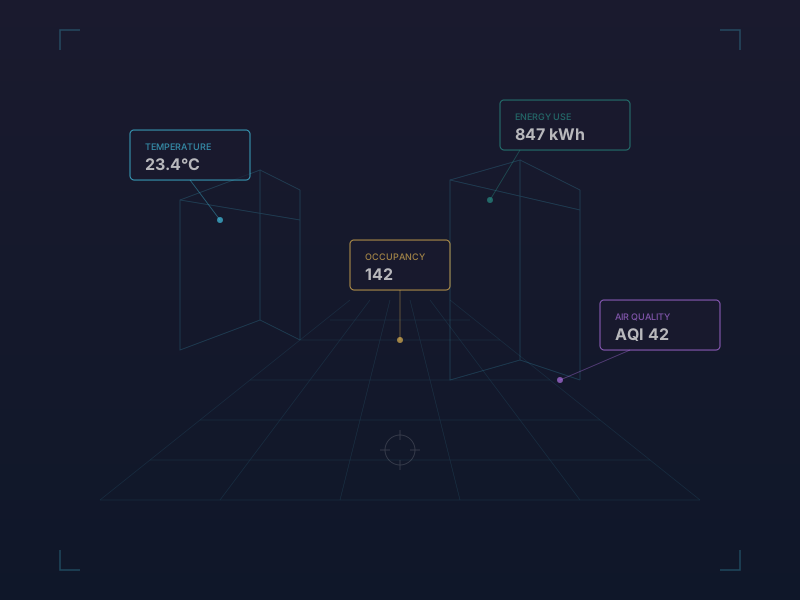
By 2018, a critical mass of researchers and startups were exploring a tantalizing question: what happens when you don't just look at data on a screen, but step inside it? The MIT Media Lab's Fluid Interfaces group, led by Pattie Maes, had been experimenting with augmented reality data overlays since the mid-2010s, projecting real-time information onto physical spaces so users could see data layered onto the world around them. Meanwhile, Kineviz, a San Francisco-based startup founded by Weidong Yang, launched GraphXR, a platform that rendered complex network graphs, geospatial data, and time-series in full 3D virtual reality, allowing analysts to literally fly through their data using VR headsets like the Oculus Rift and HTC Vive. Research from studies at institutions like Virginia Tech and Monash University found that spatial immersion could improve pattern recognition in complex datasets — people could spot clusters and outliers more quickly when they could rotate and walk through a 3D point cloud than when staring at a 2D projection. But the field also discovered real limitations: VR headsets caused fatigue, depth perception could mislead, and the lack of standardized interaction paradigms meant every platform invented its own controls. The promise of immersive data is profound — our brains evolved to navigate three-dimensional space, so encoding data spatially taps into deep cognitive wiring — but as of the mid-2020s, the technology remains more compelling as a research frontier than as an everyday tool.
VR · AR · immersive · spatial