The Permanent Collection · The Science of Visualization
Tukey's Exploratory Data Analysis
John Tukey, 1977
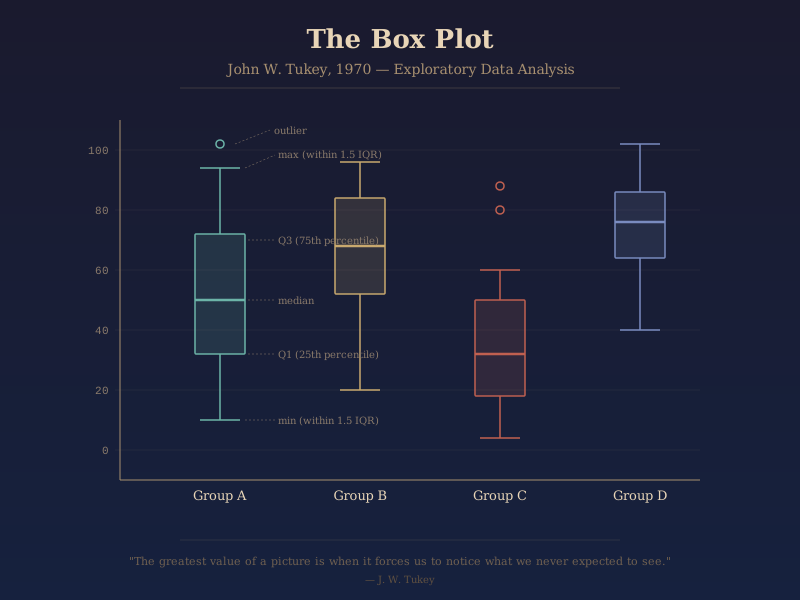
John Tukey was one of those rare scientists who could reshape an entire field with a single idea — and he did it more than once. A mathematician at Princeton and Bell Labs, Tukey invented the box plot (originally called the "box-and-whisker plot"), the stem-and-leaf display, and coined the word "bit" (short for binary digit) that became the fundamental unit of information. But his most lasting contribution was philosophical, not technical. His 1977 book "Exploratory Data Analysis" argued forcefully that statisticians had it backwards: instead of starting with a hypothesis and then looking at data to confirm or reject it (the "confirmatory" approach), you should first explore your data visually to discover patterns, outliers, and surprises you never anticipated. Visualization, Tukey insisted, was not just a way to present your final results — it was an essential tool for generating hypotheses in the first place. This was a radical departure from the prevailing statistical orthodoxy, and it met with resistance from purists who worried about the rigor of "just looking at the data." But Tukey's approach proved enormously practical and eventually won the day. He also co-invented the Fast Fourier Transform (FFT) algorithm with James Cooley in 1965, one of the most important algorithms of the twentieth century. His insistence that we should let data speak through pictures, rather than reducing everything to summary statistics too soon, is the philosophical foundation of modern data science.
box plot · exploratory analysis · statistics · Princeton · data science